Monday, November 30, 2009

Upper Cabinets in Kitchen Design

Last week I began discussions on our kitchen renovation. As mentioned we’re going with a white on white palette and have selected the cabinets, countertops and tile for the backsplash. One of the “discussions” my husband and I are having is whether or not to install upper cabinets along the wall with the windows.

Older kitchens generally have long stretches of boxy wall cabinets. This can give the kitchen a closed in feel and contribute to the space looking cramped and dark. By utilizing a wall of tile and some open shelves you maintain a look of open space and provide a canvas for displaying your beautiful dishware.

Our kitchen is going to be configured in a galley style and is only 9 feet in width. By utilizing open shelves along the wall with the windows will make the space look light and airy. Due to the number of drawers and lower cabinets, having no uppers will not affect the amount of storage available. Additionally, all of our everyday dishware will be within reach and easily accessible.

Take a look at some great kitchens designed without upper cabinets. What do you think?

jonathan adler liz lange country residence home kitchen white cabinets open shelves marble countertops counters wall backsplash dowlingkimmopenshelves 4d28d59b4ee4

Tuesday, November 24, 2009

White on White Kitchens

This is the first post I’ve done in many months and I’ve decided to discuss my personal experiences on renovating a home. My husband and I are in a perpetual state of renovations with our house. (This is what happens when a Designer and Contractor unite). Our current project is a complete renovation of our kitchen. This includes changing the current layout from a small U shape to a Galley, converting from electric over to gas for the range, installing all new cabinets, flooring and a backsplash. After looking at many pictures and contemplating what would look best with our existing style, I’ve decided to go with a white on white palette. My husband is not completely onboard with this decision, but after pleading my case, he has decided to go with the flow.

Will a white on white kitchen look too sterile and boring?
In my case I have chosen bright white glossy cabinets, with contrasting opaque white glass doors for the horizontal uppers. By utilizing two different styles of white cabinets, I’m adding visual interest and avoiding a “wall of white” with the cabinets.
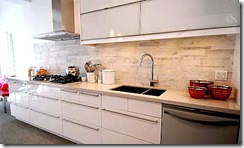
3194101731_21480c37dd_o

Remember, having a “white” kitchen doesn’t simply mean ALL white. It can include colours such as Vanilla, Eggshell and Cream. You can also change the look by adding an island in contrasting color, or selecting appliances that are stainless steel or coloured.

Weren’t white kitchens big about 15 years ago? What if it dates itself quickly?
The fact that white kitchens were popular 15 years ago and are popular still today shows the staying power of a neutral palette. A white kitchen is considered “classic” in design and will instantly make your kitchen look light and airy. Darker wood cabinets will add visual weight to your kitchen and more likely to date your look over time.

Okay, you’ve convinced me to have a white kitchen. What are some things to remember when choosing my cabinets, countertops, etc.?

marbletile2001

When you work with a monotone palette, it’s important to select pieces that will add texture. By utilizing two different styles of cabinets and adding a quartz countertop and marble tiles for the backsplash, I’m able to keep my white palette while adding depth and interest to the space.

Next week; Should I utilize upper cabinets or open shelves?

Friday, April 17, 2009

The Don’ts of Interior Decorating

We don’t all have the ability to work with an interior designer when making changes to our home. If you are considering some updates to rooms in your home. Here are some basic rules on what NOT to do.

  1. Don’t Let Someone Else Dictate Your Choices
    Your home is your personal space and it should reflect your personality. If you need help, by all means ask a professional, but a good decorator/designer will not demand that you do things their way. They will take your taste into consideration when making selections. It's your home and you should feel comfortable with the choices.

  2. Don't Select a Paint Colour First
    Paint comes in a huge array of colours. When deciding on your choices, make sure that you choose your fabric, carpet or flooring and upholstery first. Matching your paint to these selections will be much easier.

  1. Don’t Rely on a Paint Chip
    When it is time to select a paint color don’t just look at a paint chip at the paint store to make your selection. The chip may look great in the store under fluorescent light but way too overpowering on your wall at home. Additionally, paint will take on different undertones based on the lighting and direction your home faces. Once you’ve narrowed down your choices to two or three, purchase paint samples and try them on the wall, or paint large pieces of cardboard and hold them up on the wall for a more accurate picture of the final look. Be sure to leave the sample on the wall and view it at various times of day and with your lights on and off.

  2. Don't be Afraid of Bold and Settle for Beige
    A gallon of bold blue paint doesn't cost any more than a gallon of beige. If you love color, find a way to use it in your home. You can always highlight a feature wall with your bold favourite color or with some great wallpaper to really give your room some personality.

  3. Don’t Turn Your Room into a Theme Park
    If you love animal prints, don’t turn your room into a zoo! Instead choose a tasteful ottoman of zebra print or a couple tiger throw pillows. A little goes a long way. You can coordinate the room in subtle color allowing the few pieces you do have to really pop!

  4. Don't Ignore the Psychology of Color
    If you want a relaxing environment, don’t paint your walls red. Choose blue or green for a more calming effect. Colours like red and orange work great in dining rooms or family rooms, where you want the atmosphere to be more lively. Choose a colour scheme that reflects the overall atmosphere you want in your home.

  5. Don't Ignore the Focal Point of Your Room
    Every room will have a focal point. Arrange your decor, artwork and other items around this important element.

  6. Don't Put Your Furniture “Under Arrest”
    Don't arrange the chairs, sofa, and tables all up against your walls with a big open space in the middle of the room. Make smaller groupings of furniture for conversations and pull pieces into the center of the room for a warmer feeling.

  7. Don't Build Barriers
    Don't put a chair in front of a door or a table in an obvious traffic area. Leave room for easy access and movement within the room.

  8. Don't Settle for Cheap
    Don't choose a piece of furniture because of a pretty cover or fun color. First, see if it's well made, has interesting details or classic lines. If it does, you can always recover the upholstery in a fabric you choose or refinish the frame.

  9. Don't Invest in Trends
    Don't break you budget on pieces that are trendy. Trends come and go. You'll want to spend your precious resources on pieces that will last for a while. If you are attracted to crystal studded or fur-covered furniture, experiment with a less expensive crystal embellished lampshade or faux fur throw.

  10. Don't Keep Things Because You Think You Should
    Don't feel obligated to keep a piece you've inherited. If it doesn't appeal to you or it doesn't fit your space, either fix it or get rid of it. After all, it's your home. They'll understand!

  11. Don't Display Every Personal Treasure
    Don't overcrowd your home with collectibles and family photos. Make each piece be important. Keep your family photos confined to a bedroom or one wall. Your guests aren’t as interested in Aunt Betty’s 50th birthday celebration or the 5th Grade picture of your daughter.